

How to Keep Track of a Foster Child’s Belongings Without Losing Your Mind
If you are a foster parent, you already know how fast the kids’ belongings can disappear into the chaos of daily life. Clothing sizes change overnight, toys migrate to impossible places, comfort items get lost right when they are needed most, and nobody can remember who outgrew what.
On top of that, many states require foster parents to keep detailed records of the kids' belongings. California, for example, requires foster parents to maintain an inventory of clothing, toys, and personal items, along with the condition of each item for each child. Other states have similar guidelines or expectations, even if they are not written as clearly.
The responsibility is a lot. And trying to track it all in your head can make you feel like you are slowly losing it.
That is exactly why I started creating a belongings system that actually works.
Why Tracking Belongings Matters
Keeping an updated list of the kids’ belongings is not only a licensing requirement in some places, it’s also incredibly helpful for everyday life.
Good records make it easier to:
Know what sizes the kids currently wear.
Keep track of the condition so you know what needs replacing.
Support social worker visits and placement reviews.
Prepare for school, respite, or transitions.
Avoid last-minute shopping panic.
Make sure the kids keep the items that belong to them during reunification or transfer of care.
Kids in foster care often move with very little. The items they do have matter. Tracking their belongings helps protect what belongs to them while also making sure they have what they need.
The Problem With Paper Lists
Most foster parents start with a notebook, a binder, or the notes app on their phone. And while this works for a few days, the system starts to crumble the moment a size changes, a new pair of shoes appears, or someone buys a winter coat that nobody remembers to write down.
Paper gets lost. Notes apps get messy. And when the social worker asks for a list or a placement meeting comes up, you are left scrambling to remember what the kids actually have.
It does not have to be that hard.
A Better Way: The Clothing and Personal Items Tracker
I built the Foster Care Child Belongings Tracker because I needed something simple and flexible that kept everything in one place. And it updates as quickly as the kids grow.
Here is what it tracks:
✔️ Clothing sizes and shoe sizes
✔️ Condition of items so you know what needs replacing
✔️ Toys and comfort items
✔️ Personal essentials
✔️ Medical devices
✔️ A “replace soon” checklist for fast shopping
✔️ One clean master list that feeds a simple dashboard
I designed it to be beginner-friendly. You can scroll through one table, enter a bit of info, and instantly see what is missing or what needs attention. No formula knowledge needed.
Why This Helps Foster Parents
Tracking belongings is more than a task. It helps create consistency and stability. Kids who have been through multiple homes often worry about losing things. A good system helps them feel secure, and it helps you advocate for what they need.
It also makes placement reviews, social worker meetings, and school prep a whole lot easier. When you can quickly pull up what clothing each child has, what condition it is in, and what still needs to be purchased, you save time and reduce stress.
And honestly, anything that reduces stress in foster parenting is worth its weight in gold.
From One Tired Parent to Another
You do not have to track all of this in your head. You do not have to keep starting over with new notebooks. And you do not have to feel guilty for not remembering which kid outgrew their winter boots.
The right tool can make a big difference in the daily chaos.
If you want to try the Clothing and Personal Items Tracker, you can find it in my shop. It is built to grow with your family and make the mental load a little lighter.
You got this <3
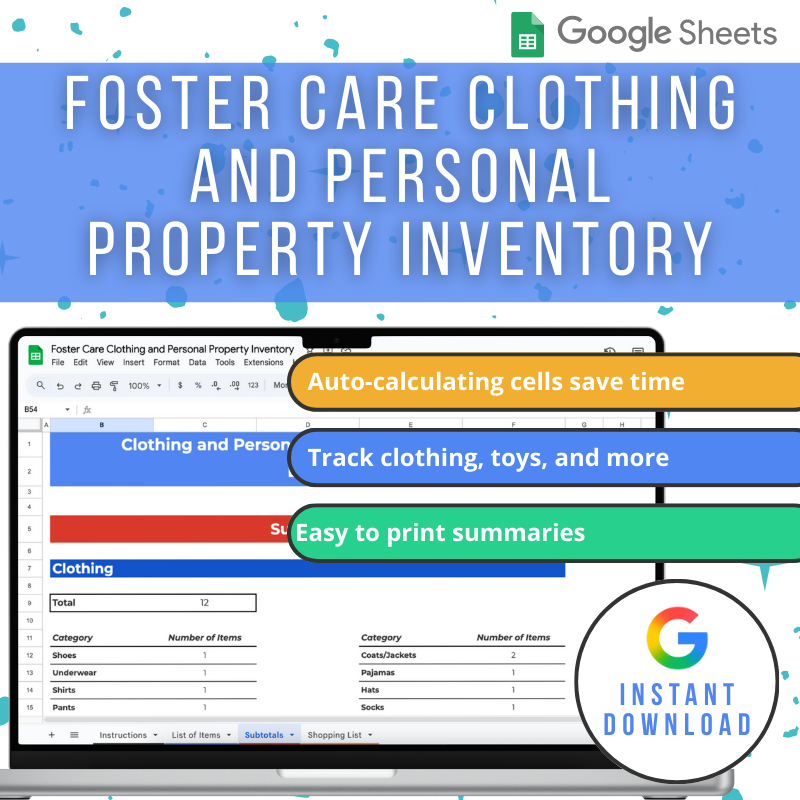
This Clothing & Personal Items Tracker keeps everything in one simple place. Clothing sizes, toys, comfort items, personal care items, medical devices, and anything else that tends to disappear into the black hole of daily life.
It’s clean, it’s flexible, and it works for families with one child or can easily be copied for the whole crew.
What It Tracks:
✔️ Clothing sizes and shoe sizes
✔️ Condition of items so you know what needs replacing
✔️ Toys and comfort items
✔️ Personal care essentials
✔️ A "date last checked" for each item that turns red if it has been over 60 days
✔️ “Needs” list for fast shopping trips
✔️ One master list that feeds a simple dashboard
Features Included:
✔️ Google Sheets workbook for easy updating
✔️ Printable sheets for quick handoff to social workers
✔️ Dashboard tab with quick summaries
✔️ Shopping list based on anything that has the "replace soon" condition
✔️ Category filters for Clothing, Shoes, Toys, Personal Items, and more
✔️ Simple instructions tab written by a tired foster dad for other tired parents
Perfect For:
✔️ Foster parents
✔️ Adoptive parents
✔️ Kinship caregivers
✔️ Respite providers
✔️ Anyone managing multiple kids, sizes, and needs
This tracker takes the mental load out of remembering who needs what. Just update the list, check your dashboard, and move on with your day.
